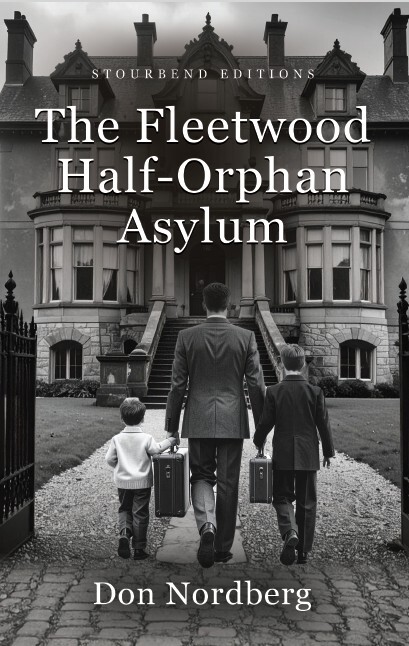
The Fleetwood Half-Orphan Asylum, a novel

It’s 1927, in Middleton, somewhere in the middle of the United States.

After their mother vanishes, two young brothers – Amos, 12 and Horace, 10 – find themselves facing a six-month stay at an orphanage while their father sorts out his life. Three years on the elder son runs away, leaving the younger behind. The brothers meet again for the first time after more than thirty years at their father’s deathbed. They fight and storm out of the house in different directions.

Thirty-odd years further on, Horace’s son receives a letter and a notebook, offering revelations about his family’s history. If only he’ll come half-way across America …

The Fleetwood Half-Orphan Asylum is a story of brotherhood and family secrets. It deals with race, religion, what caring means, and – most of all – love and the absence thereof.

5* reviews on Amazon and Goodreads:

“THE FLEETWOOD HALF-ORPHAN ASYLUM is an inventive novel that provokes serious thought and offers numerous insights. It is artful, engaging and highly recommended.” – Robert Crooke, author of Letting the House Go and other novels

“This is a beautifully written, deeply humane novel about brotherhood, loss and the long shadows cast by family silence. … This is a thoughtful, moving and richly layered novel about the need for love and belonging across a lifetime. I found it deeply affecting and warmly recommend it.” – Natalia

 Get my novel, The Fleetwood Half-Orphan Asylum, at Amazon, other retailers – or with a subscription to “Don Nordberg (is/on) writing

Two Substacks …

… dealing with two lines of inquiry.

The first deals with writing. Book reviews, comments on long-format television drama and other writing – and my own writing. It’s called Don Nordberg (is/on) writing:

It builds on my long interest in literature, my (new, second) PhD from the University of Exeter, and the fiction and other writing I plan to publish.

The second deals with governance, corporate and otherwise. It’s called:

It builds on longstanding interests in politics, organizations and ethics and my (older, first) PhD from the University of Liverpool, as well as my continuing work on the boards of two large charities, one in social care, the other in the performing arts.

Both contain short analyses with links to further materials online. Subscribe! They’re free. You’ll get updates about one a week. Both are open to comments and debates.

A pragmatist case …

Ethics in the boardroom is fraught with complexity. Whose interests do directors protect? Whose causes do they advance? On what basis – what ethical considerations – do they make those determinations? And how do they come to consensus about what is the right thing to do, or the right way to do it? These issues are aired in a collection of essays complied by Till Talaulicar in a new Research Handbook on Corporate Governance and Ethics, published by Edward Elgar.

My contribution to it is called “A pragmatist case for thoughtfulness and experimentation in corporate governance.” It conducts a series of thought experiments and considers how directors – you and I – might reason our way to a decision. The chapter builds a case for act-based ethics, rather than following rules, especially when the situations are novel and directors are divided over which type of ethical consideration apply.

Governing corporations with ‘strangers’

“Despite decades of theorising and empirical research, the problems of corporate governance seem intractable, particularly the relationships between investors and companies. The thought experiment in this paper asks us to look at the problem through a fresh lens. It draws on the quaint British legal custom of calling shareholders “members”, and then uses the political philosopher Michael Walzer’s idea of membership in states, clubs, neighbourhoods, and families to draw lessons for the corporate world. This paper suggests that seeing how Walzer conceives “strangers” in a polity, with fewer rights but a path to membership, lets us rethink shareholder rights as something to be earned, through engagement and commitment, that is, through stewardship. Rethinking what membership of a company might mean points to a pragmatic escape from short-termism without institutional reform.”

Read this paper in the journal Philosophy of Management.

Enacting ideas in fiction, or exploring them?

In this piece of literary criticism, I examine the question of how ideas manifest in two contemporary books we might well call “novels of ideas“. The paper’s abstract goes like this:

“Philosophically engaged fiction often employs ideas in ways that reflect the exploitation-exploration dilemma in developmental psychology: by exploiting well articulated theories by enacting their conflicts, or by exploring the uncertainties of puzzling ontologies or moral complexities. We can see this in action in many works, but some novels of ideas seek to defy such categorization, with lessons for readers and writers. This paper analyzes two recent works – The Overstory by Richard Powers (2018) and Elizabeth McKenzie’s The Portable Veblen (2016) – to show how they deal with related concerns and settings through very different approaches. While Powers offers an enactment, its complexity seeks to evade the book becoming a simple polemic. McKenzie’s protagonist explores her muddled identity, philosophy and much else while flirting with the enactment of ideas when she does not comprehend.”

You can read the full paper in the journal New Writing.

#literary criticism, #novel of ideas, #enactment, #exploration, #The Overstory, #The Portable Velben

A ‘new corporate landscape’?

In a review of a new book, I examine the proposition that corporations occupy a bigger part of the landscape of political economy. Alexander Styhre makes a combined historical and contemporary case for it in his The New Corporate Landscape: Economic Concentration, Transnational Governance, and the Corporation. But after covid and then the war in Ukraine, in which states reasserted control over our lives, I ask:

“Is the book … accidentally an anachronism? And does its analysis matter to organizations themselves and the scholars who study them? The answers to those questions are No and Yes, though we need to use Styhre’s insights as prompts to think beyond the scope of his work.”

You can read the rest in the journal Organization Studies. There’s also a version in the repository at Bournemouth University.

Theory as ‘lens’?

Scholars often say they examine problems using a “lens”. Sometimes it’s a “theoretical lens”. Others use a “philosophical lens”. But most leave the metaphor they employ undiscussed, let alone defined. In this working paper, I examine that metaphor and detect four different meanings in two categories – lenses that help us see better and one that let us see differently. An updated version, including a couple of worked examples, appears now as “The lens of theory: Seeing better or differently?” in the International Journal of Organization Theory & Behavior.

#theory #lens #research methods

How do boards decide? How does stewardship arise?

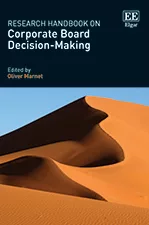
That’s the subject of a new research handbook. I’m one of the contributors. Oliver Marnet has pulled together writers from across the landscape of corporate governance for a book published by Edward Elgar, Research Handbook on Corporate Board Decision-Making. My chapter is: “Liminality, purpose, and psychological ownership: Board decision practices as a route to stewardship,” in which I argue that the way board conduct their deliberations can facilitate or impede the sense of commitment of directors. You can find it from the publisher here. The manuscript can be found in the Bournemouth University repository.

#corporate governance #stewardship #psychological ownership #boards of directors

Enactment and exploration: two roles for philosophy in the novel of ideas

Here’s a theoretical perspective on the novel of ideas, published in the journal Philosophy and Literature.

Abstract: I examine the often-denigrated concept of the novel of ideas from its inception, its critical decline, to its relatively recent revival. Using a variant of the exploitation-exploration dilemma in psychology, it suggests that early usage referred to works that exploit philosophical principles – or better put, enact them – by setting philosophical positions in conflict. By contrast, use of the concept for other, and especially more recent works sees characters and plots as exploring philosophical stances. The shift corresponds with the greater attention paid to complexity and ambiguity that are hallmarks of continental philosophy and neopragmatism, and with it greater need to explore philosophical stances through fiction.”

It’s available from Johns Hopkins University Press.

Steering a business to success…

As part of its podcast series, Dorset Growth Hub invited me to discuss the role that boards – and corporate governance more generally – can play in smaller businesses. Theorists often talk about how boards play two contradictory roles: “service” – providing insights and access to key resources – and “control” – stopping a runaway executive.

But from my own board experience, I’ve seen how hard it is to separate the two. Let’s think about how serving on a board is like driving a car, I suggested, and then asked: “Why do they put brakes on cars?” Here’s the answer!

LinkedIn

Facebook

Listen online: https://bit.ly/3r5Gx1U
Listen on Spotify: http://spoti.fi/3ccWwq9
Listen on Apple: http://apple.co/317r86n
Listen on Google Podcasts: http://bit.ly/317JDr0
Listen on Amazon Podcasts: https://amzn.to/3lHOqcb